 It is not altogether clear that conventional fatigue actually takes place in ceramic materials. Failure over time does occur in brittle materials, however, despite the absence ö(the crack tip plasticity that is the hallmark of materials known to exhibit fatigue. One category of failure with-time in glasses and ceramics known as static fatigue is actually stress-corrosion cracking promoted by moisture.
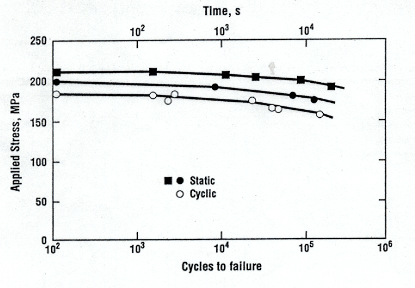
Recent results from a tension/compression cycling study of alumina indicate that fatigue-crack extension may occur. In this study, time to failure from a steady stress was compared to a tension/compression fatigue test at equivalent peak stress. Consistently shorter failure times were seen in the cyclic mode.
Crack-velocity data for glass and porcelain indicate that true fatigue effects are not important in these materials. Some preliminary data on SiN, at elevated temperatures have also failed to show significant material degradation that could be traced to stress cycling.
Some of the latest work done to quantify fatigue effects on ceramic materials has been undertaken by Surya Pattanaik for IBM. His search for data on cyclic stress behavior of piezoelectric ceramics revealed the paucity of research in this area and inspired him to setup his own testing program. Although limited to a cyclic frequency of 3 Hz by his test equipment, Dr. Pattanaik conducted tests at from 350Q to 7500 psi (70% of the fracture strength) on indented PZT specimens mounted on a four-point bend fixture for durations of millions of cycles.
The most rapid time to failure for a test bar was 700 cycles (the crack provided by the indenter was placed in tension by the fixture) A comparison of cyclic with static failure data for ploycrystalline alumina may indicate a tendency toward earlier failure from cyclic fatigue (after Chen and Knapp) at a peak applied stress of 7500 psi. Specimens exposed to 4900 psi have lasted in excess of 2 million cycles.
Once again, however, the manner in which the PZT ceramic ultimately failed showed none of the earmarks metallurgists are used to seeing when a material such as aluminum approaches fatigue failure. According to Dr. Pattanaik, careful scanning electron microscopy has not revealed a progressive failure mechanism that can satisfy him that fatigue in progress can be diagnosed in such materials.